Wednesday, September 19, 2012

12•21

12·21 by Dustin Thomason

Back in 2004 Dustin Thomason co-wrote a book with Ian Caldwell called The Rule of Four. It was very popular and stayed at the top of the NYT Bestseller list for months. I read it, but wasn't that impressed. It was a decent book, but it wasn't the second coming of The Da Vinci Code some seemed to think it was. Now, nearly nine years later, Thomason has written his second book, this one by himself.

If you're one of those people who doesn't have anything on their calendar scheduled after December 21, 2012 or who is maxing out their credit cards because they don't believe they're ultimately going to have to pay it back thanks to the Mayans, than this book is right up your alley. Most people know by now that they Mayan calendar ends on 12/21/12. Something will cause the polarity of the earth two reverse and life as we know it will end. 

When 12·21 begins, two weeks prior to that date, two things enter the United States undetected: the first is an ancient Mayan codex that had been looted from a previously undiscovered Mayan temple in Guatemala and was smuggled into the States in order to be sold. The second is a disease--brought in unknowingly by the same Guatemalan man looking to strike it rich with the codex, who was infected by the disease while at the ancient temple site.

The disease is similar to mad cow disease in that it affects the neurological system and has no known cure, but instead of being spread through the consumption of tainted meat, this disease spreads like a common cold. The disease takes only days to incapacitate its host and is almost always fatal.

Dr. Gabe Stanton is a specialist with the CDC whose career has been spent trying to find a cure for mad cow and other diseases known as "prion diseases." When this knew variant of the disease starts to spread Gabe finds himself at the forefront of the efforts to track down where it originated from and hopefully be able to discover its cure.

I'm pretty lukewarm about 12·21. It was interesting and fun to read, but I was unsatisfied with the ending. My recommendation would be to wait till after the real 12·21 to read it. If our days are numbered, don't waste your time with it, but if they're not, and we're all still here the morning of the 22nd, then give it a try.

★ ★ ☆ ☆ ☆

Thursday, September 13, 2012

Les Misérables

Les Misérables by Victor Hugo
First of all, there are two versions of Victor Hugo's Les Misérables: the complete version and an abridged one. I read the complete version. I don't think reading an abridged version really counts for anything. For me, reading an abridged version of a book is kind of like getting a GED--sure, you can tell people you did it, but how many people do you really think are impressed?

Several years ago I took an Amtrak train about 500 miles to Denver to meet up with my family at my in-law's. Several people tried to convince me beforehand that I'd really enjoy it. They were full of crap. The train departed at about 5:00 AM and didn't pull into Denver until after 10:00 PM. I normally drive that trip in about 7½ hours, so this was tortuous. Periodically throughout the trip, the train would just stop, not at a station, or at a point where passengers were getting on or off, just on the tracks. Sometimes the stop would last for a few minutes, other times the stop would last for over an hour. No explanation was ever given, so each time it'd stop, I would go crazy not knowing how long the stop would take, and knowing that I wasn't making any progress towards my destination. I was reminded of this train trip numerous times while reading Victor Hugo's Les Misérables. But while I hated the train ride with a passion, my feelings about Hugo's book are quite the opposite.

The reason the book reminded me of that train ride was because Victor Hugo repeatedly stopped his story of Valjean, Javert, Cosette, and Marius to give a history lesson, or background on an influential person of the book's time period, and these stops were rarely brief. At one point he used 50 pages to describe the battle of Waterloo before telling you that Thénardier was there after the battle ransacking valuables from the corpses of soldiers and while doing so, had an interaction with Marius's father. That chapter could have been 49½ pages shorter and would have been just fine.
Having said all that about what I could have done without in the book, I'll shift gears now and say how glad I am that I finally got around to reading it. It's truly a fantastic story and ultimately a great book. I think it's a waste of time to summarize the plot, as I believe most people know it, or at least part of it from the musical production. But as good as that is, it pales in comparison to the book. Hugo acts as narrator throughout the story and as someone who lived in Paris at the time, who saw firsthand the struggles of its citizens, and the building of the barricades during the rebellion that took place, he's able to provide incredible depth to the story he tells.

Ironically, I think that Hugo was a master at using the written word. As I said earlier, sometimes it was to excess--and I'm going to attribute that to my hunch that publishing houses in the 1860's didn't employ editors. But there were numerous times that Hugo would write a sentence or two, either as narration or as dialogue spoken by a character, that I thought were brilliant. In those parts of the book, Hugo was able to express an idea that perfectly described a characteristic of mankind, or a universal truth that few would be capable of articulating that well.

This winter a new movie adaptation starring Hugh Jackman will be released. My suggestion is instead of going to the theater and paying $9 and spending probably three hours watching an interpretation of the book, rather go to a bookstore and pay $9 and get to spend a month reading the original. But if you end up reading the abridged version, don't bother telling me about it. I won't be impressed.

★ ★ ★ ★ ★

Thursday, August 16, 2012

The Wind Through the Keyhole

The Wind Through the Keyhole by Stephen King

My favorite books of all time are Stephen King's Dark Tower series. They're fantastic. The fact that my wife wasn't crazy about them only shows that her good taste in men doesn't carry over to books. That being said, when I heard that King was going to be revisiting the series years after it was concluded with another story, I was moderately conflicted. On the one hand, the fact that I like the books so much should mean that I'd enjoy a new book just as much. On the other hand, the series was over, the story had been told and I didn't want King to turn into George Lucas who can't seem to leave a good thing alone. My concerns proved to be unwarranted. The book was just as good as the rest of the series and it fit in perfectly.

Chronologically the book takes place between books 4 & 5. Roland and his tet are taking shelter along the path of the beam from a deadly storm called a Starkblast. While they're there Roland relates two stories, or rather, a story that includes within it, the telling of another story. The story he tells took place when Roland first became a Gunslinger. He and Jamie DeCurry were sent to Debaria to look into reports of a skin-man (a shape-shifter), who had killed dozens of its residents. A young boy named Bill Streeter survived one of the attacks and Roland needs him in order to identify who the skin-man is while in human form.

While he's keeping watch over Bill one night, he tells him a story that comes from the Magic Book of Eld. That story is about a young boy who went on a dangerous journey in order to seek out the magician Maerlyn who he believes can cure his mother's blindness.

Each of the stories contained within this book is great. The book illustrates once again why King is head and shoulders above all his peers. If you've never read the DT series, I HIGHLY recommend it. But not until you've read other books by King that tie into the series first: The Stand, Salem's Lot, Insomnia, It, The Eyes of the Dragon, & The Shining. There are several other books and short stories that have a connection to the series, but the connections are pretty superficial and it really doesn't matter which you read first.

★ ★ ★ ★ ☆

Tuesday, August 14, 2012

The Sign of Four

The Sign of Four by Sir Arthur Conan Doyle

A couple of years after introducing the world to the detective on Baker Street in A Study in Scarlet, Doyle followed up with The Sign of Four. In it Holmes and Watson are solicited by a woman named Mary Morstan, whose father died under unusual circumstances years ago and who for the past several years has been receiving an anonymous gift in the mail every year - a rare and beautiful pearl.

As the pair investigate both the death of Miss Morstan's father as well as the origins of the pearls, they discover that the pearls are part of a much larger treasure, a treasure that was discovered and hidden years ago by four men. Among those four men were Miss Morstan's father and the father of the man sending the pearls. Once again Sherlock Holmes uses his remarkable powers of observation and deduction to solve the mystery surrounding the four men and the treasure.

★ ★ ★ ☆ ☆

Thursday, August 9, 2012

The Long Earth

by Terry Pratchett & Stephen Baxter
(The Long Earth series #1)

You can do a lot with a potato. You can mash it, bake it (once or twice), broil it, turn it into french fries, potato chips, etc. If you're Dan Quayle, the "potatoe" was a source of never-ending torment and ridicule. Terry Pratchett and Stephen Baxter use it to power a device that allows people to "step" across to alternate versions of planet earth.

See, the earth isn't a single planet, it's merely one in a series of planets that have existed linearly since the universe began. When this long chain of earths began, they were essentially identical, but as eons passed, they became wildly divergent. The things that happened on and shaped the world we live on, didn't happen on all the other earths. On some, the meteor strike that led to the extinction of the dinosaurs never took place. On some, life never made its way out of the oceans. Life on each planet, if it was able to, evolved along an independent path.

In the first quarter of the 21st century, this earth saw the invention of the "stepper." The stepper was essentially a box, simple enough that almost anyone could build. Throw in some wires, a spring or two, and a potato to power it, and it enabled a person to step to the next earth in either direction. The inventor of the stepper put the instructions for building it online to ensure that the ability to step was available to anyone who wanted it. And many did.

Inner cities started to empty as people sought a better life on supposedly uninhabited planet earths. Those burdened with debts sought a fresh start. Adventurers now had an unlimited number of places to explore and gradually the diffusion of humans across the Long Earth grew.

But there are some people who don't require a stepper to step. It's realized that some people can do it naturally and it's discovered that the ability to step has been around for thousands of years, and not every stepper is human.

I'll read anything with Terry Pratchett's name on it. He's one of my favorite authors and it will be a sad day for me if and when he looses his battle with a form of Alzheimer's. I had however, never read anything before by Stephen Baxter. I had heard about him and seen his name on books coauthored with Arthur C. Clarke, so I assumed he was pretty good as well. Turns out, he is.

For me though, The Long Earth took awhile to get going. For most of the book I felt like the plot was conspicuously missing. The premise of the story was great, and the description of the different worlds was wonderful, but I wanted a compelling plotline to follow too. This book also showed a different side of Terry Pratchett. It's humorous, but not anything like his Discworld series.

I shouldn't make it sound like I didn't enjoy the book, because I definitely did. It's incredibly creative and I look forward to follow-up books to be written. But I do feel like it took a little too long to get to the plot, and the pace of the story was a little too uniform. Hopefully that's just because it's the first in a new series and the authors wanted to take the time necessary to set the stage for things to come. Because the Long Earth offers an unlimited supply of future stories.

★ ★ ★ ★ ☆

Monday, July 30, 2012

Partials

by Dan Wells
(The Partials series #1)

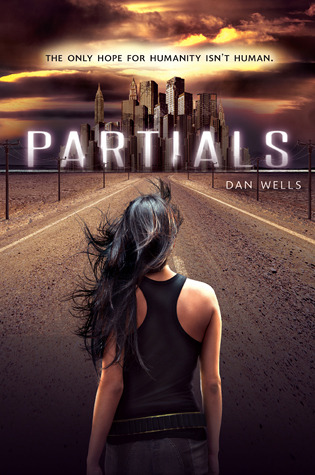
Dan Wells is the author of the John Wayne Cleaver trilogy consisting of I Am Not a Serial Killer, Mr. Monster, and I Don't Want to Kill You. If there's a series of books with more intriguing titles, I'm unaware of it. I enjoyed those books a lot and so I was looking forward to whatever he wrote next. When I found out it was a sci-fi book for young adults, it didn't dampen my enthusiasm. I've read a lot of really good books that were written for younger readers. But when I saw the cover of the book, I hesitated. It looked like a lot of the books my 13-year-old daughter reads and I didn't want to appear too creepy reading on the train to and from work each day. So I took the book cover off while reading it.

The book takes place 60 or so years into the future. In a time when there are less than 100,000 people left on earth. During a war with the Partials--genetically engineered beings almost indistinguishable from humans but stronger and with heightened senses, a weaponized virus known as RM was released that killed over 99% of the population and has continued to kill every baby born since then. The youngest people on earth are now teenagers and everyone lives under the constant threat of another attack by the Partials.

Kira is a teenage medic-in-training who works in the maternity ward of the hospital. Every day she sees babies being born knowing full well that they won't live long. She believes that if the humans are going to have any chance of surviving, the research being done on the virus has to change. RM has been analyzed and tested in every possible experiment in order to find a cure, but without success. Kira realizes that the only hope still out there are those who released it--the Partials. 

After the war, the Partials retreated and haven't been seen since, but it's understood that they were immune to the virus. If a Partial could be found, captured, and analyzed, maybe a cure could be found. 

I enjoyed the book. It was darker and more mature than most books written for young adults are. In fact, if it didn't mention the fact that it was for younger readers on the back of the cover, I never would have picked up on that from reading it. There's some minor profanity here and there, and the subject matter is pretty mature in nature. I won't be letting my daughter read it for another couple of years. But there's a follow-up book coming out soon, so maybe it'll be another trilogy. If so, maybe I'll let her read them all once it's done.

★ ★ ★ ☆ ☆

Tuesday, July 24, 2012

A Study in Scarlet

A Study in Scarlet by Sir Arthur Conan Doyle

Several years ago I started reading Doyle's books featuring the iconic detective from Baker Street. But for reasons I can't explain, I read the first four stories and then never went back to find out what happened to Holmes after plummeting over the waterfall with Moriarty. (Sorry, but I'm not going to include spoiler alert warnings for a book written in the 1890s.)

I was recently introduced to the BBC's series Sherlock featuring Benedict Cumberbatch, and having enjoyed it as much as I did, and recognizing that there will probably be an extended waiting period until the third season arrives, I decided it was time to go back and read them all this time around.

 A Study in Scarlet is the story that introduced the world to Sherlock Holmes. In it he takes up residence with Dr. John Watson, who is quickly pulled into Holmes's world of deductive reasoning and crime solving. Holmes has established himself to Scotland Yard and every other police agency in London, as the man to go to when the solution to a mystery is beyond their abilities.

This mystery involves a murder. The body was found surrounded by blood. But the blood didn't come from the victim, as there were no wounds on the body. Written in blood on the wall was the word RACHE and a small gold ring, too small for the victim's hands, was found nearby. How did the man die? Who's blood was at the scene? What's the meaning of the word in blood? And what does it all have to do with those peculiar Mormons thousands of miles away?

Interesting to me is the fact that A Study in Scarlet has been the source of debate because of its not-so-flattering portrayal of Mormons. As recently as August 2011 it's been banned from public libraries (and not in Utah) because of it. As a Mormon myself, I'm baffled at how anyone today could take offense to it. If anything, it added to my enjoyment of the story.

★ ★ ★ ★ ☆