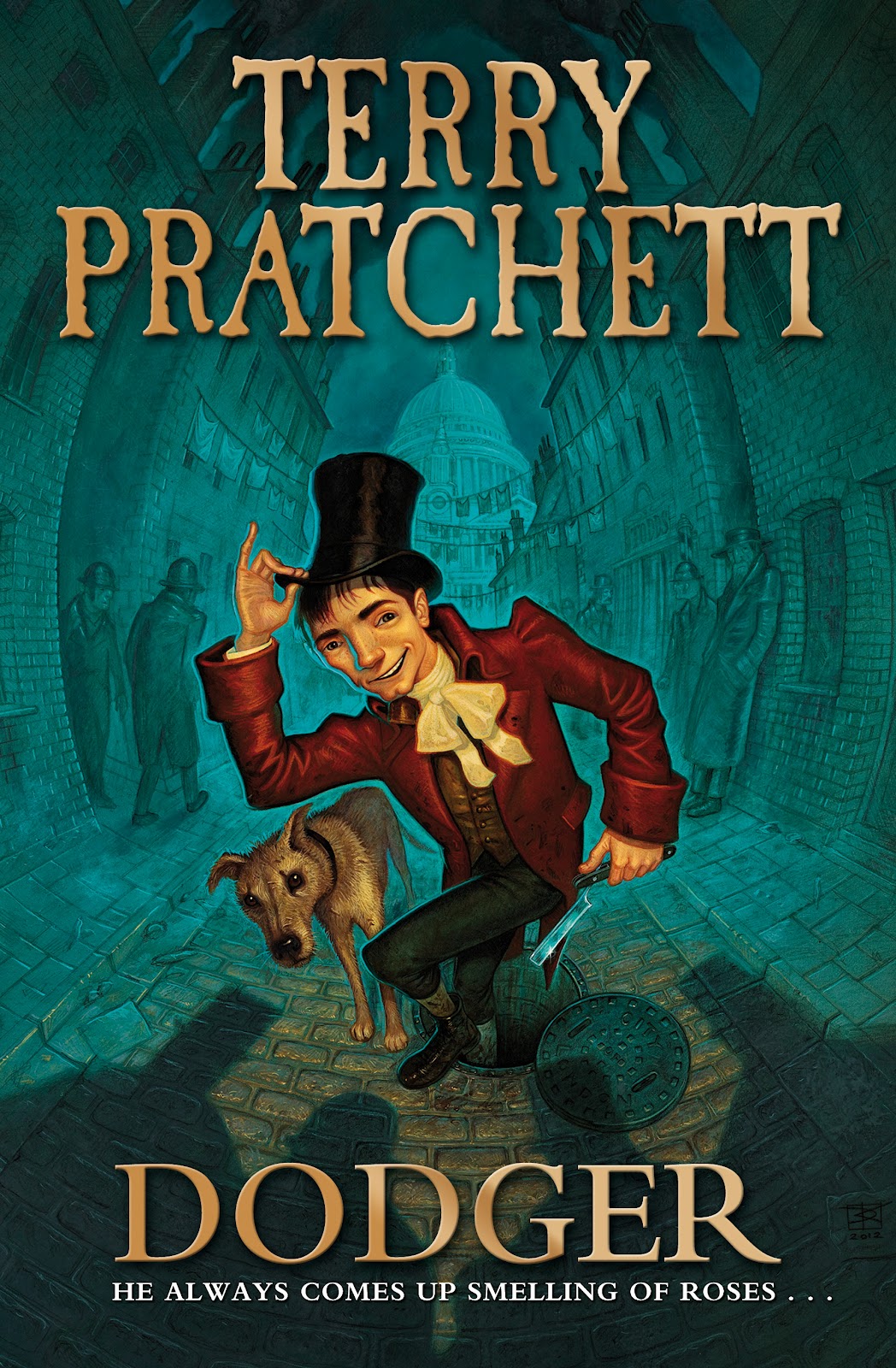
by Terry Pratchett
When I first learned that Terry Pratchett was coming out with a book featuring Dickens's Artful Dodger, I figured it would either be the story of Oliver Twist told from Dodger's perspective, or it would be the story of Dodger's life either before or after the events of Dickens's book. Both assumptions were wrong. Instead, he takes the character created by Dickens and places him in London at the same time that the young Charlie Dickens is a reporter and up-and-coming author and has their paths cross.
During an intense rainstorm on the streets of London, Dodger , who lives in the sewers below the city, and who survives by his cunning and quick hands, witnesses a woman leap from a fast-moving horse-drawn carriage in an attempt to flee her captors, who run her down and begin to beat her. Dodger chases the men off and quickly becomes enamored with the young and attractive woman named Simplicity.
Dodger's act of heroism is witnessed by two men, Henry Mayhew and Charles Dickens. The men take her to Mr. Mayhew's home where she can be looked after and recover while they, with Dodger's help, begin investigating who the men Simplicity was fleeing from were, and why she felt the need to escape.
While assisting with the investigation, Dodger wants to make himself more presentable to Simplicity by improving his appearances. he decides to get his hair cut and chooses a "Barber and Expert Butcher" who has hung out his shingle on Fleet Street. Dodger inadvertently causes the arrest of the murderous barber, Sweeney Todd, and becomes a celebrity throughout London, which ends up hindering his investigation efforts and ultimately sets his life on a new course above the sewers he once called home.
Dodger was a good book. It lacked the usual Pratchett sense of humor, which readers of his Discworld series will miss, but that shouldn't deter anyone from reading it. He's a master storyteller, and both his usual readers as well as those who have never picked up one of his books before will enjoy this one.
★ ★ ★ ☆ ☆
Thursday, February 21, 2013
Wednesday, February 20, 2013
The Sweet Forever
by George Pelecanos
(D.C. Quartet series #3)
In The Sweet Forever George Pelecanos picks up the story of Marcus Clay and his best friend Dmitri Karras ten years after the events told of in King Suckerman. It's March of 1986 in Washington D.C. and March Madness is in full swing, with first team All-American Len Bias leading the University of Maryland team into the second round of the big dance. But the same thing that will end bias's life two days after the Boston Celtics draft him second overall in the upcoming NBA draft is causing a war on the streets of the District--cocaine.
Karras himself is quickly progressing from being a casual user of the drug to a habitual one, and works for Clay, helping him run his four record shops in various parts of D.C. One day both of them witness a deadly car accident which takes place right in front of one of the shops. They watch as a car being driven by a young drug runner for the area's supplier of cocaine crashes, decapitating the driver. What they don't see is what a bystander named Eddie Golden does immediately after the crash occurred. Eddie had driven his girlfriend into that part of the District to score a gram of cocaine and witnessed the crash as well. he was the first one to approach the burning vehicle to see if he could help anyone. When he gets there he sees the state of the driver but then notices a pillowcase full of cash in the backseat. He impulsively grabs it and flees the scene, unknowingly setting off a series of events that will lead to several deaths, force Karras to reassess his life, and drag Marcus Clay into a battle for the streets of the city he loves.
This is the third book in what's known as Pelecanos's D.C. quartet series, but the books are so loosely related to each other that reading them in order is unnecessary. As I have with each of his books that I've read, I enjoyed this one. The story is engrossing and even though many of the characters live a lifestyle that I would never want to be able to relate to, the characters are still multi-dimensional and relatable. And even though Pelecanos usually shows the less appealing side of the nation's capitol, it's obvious from the way he writes about it, that it's a city that he knows very well and is close to his heart.
★ ★ ★ ☆ ☆
(D.C. Quartet series #3)
In The Sweet Forever George Pelecanos picks up the story of Marcus Clay and his best friend Dmitri Karras ten years after the events told of in King Suckerman. It's March of 1986 in Washington D.C. and March Madness is in full swing, with first team All-American Len Bias leading the University of Maryland team into the second round of the big dance. But the same thing that will end bias's life two days after the Boston Celtics draft him second overall in the upcoming NBA draft is causing a war on the streets of the District--cocaine.
Karras himself is quickly progressing from being a casual user of the drug to a habitual one, and works for Clay, helping him run his four record shops in various parts of D.C. One day both of them witness a deadly car accident which takes place right in front of one of the shops. They watch as a car being driven by a young drug runner for the area's supplier of cocaine crashes, decapitating the driver. What they don't see is what a bystander named Eddie Golden does immediately after the crash occurred. Eddie had driven his girlfriend into that part of the District to score a gram of cocaine and witnessed the crash as well. he was the first one to approach the burning vehicle to see if he could help anyone. When he gets there he sees the state of the driver but then notices a pillowcase full of cash in the backseat. He impulsively grabs it and flees the scene, unknowingly setting off a series of events that will lead to several deaths, force Karras to reassess his life, and drag Marcus Clay into a battle for the streets of the city he loves.
This is the third book in what's known as Pelecanos's D.C. quartet series, but the books are so loosely related to each other that reading them in order is unnecessary. As I have with each of his books that I've read, I enjoyed this one. The story is engrossing and even though many of the characters live a lifestyle that I would never want to be able to relate to, the characters are still multi-dimensional and relatable. And even though Pelecanos usually shows the less appealing side of the nation's capitol, it's obvious from the way he writes about it, that it's a city that he knows very well and is close to his heart.
★ ★ ★ ☆ ☆
Wednesday, February 13, 2013
American Decameron
by Mark Dunn
I assume that Mark Dunn likes to challenge himself as a writer. For him, it doesn’t seem like just writing a great book is enough of one though. He’s got to find a way to tell his story in a way that’s unique, original, and that adds an extra level of enjoyment for those who read it.
With his first and probably most widely read book Ella Minnow Pea, he wrote a story in epistolary form while progressively limiting the letters of the alphabet that he could utilize. With Welcome to Higby he prefaced every chapter of the book with an obscure biblical verse that foreshadowed the contents of the chapter. In Ibid: A Novel he writes a fictitious biography of Blashette, a three-legged circus performer and deodorant salesman. On almost every page of the book Dunn includes footnotes. And the footnotes are what tell the true story Dunn is writing.
With a nod of his head to Giovanni Boccaccio, a 14th century Italian author who wrote Decameron, a book consisting of 100 tales, Dunn uses for the subject of his story, 20th century America. Dunn's 100 tales are independent stories that span the years 1901-2000 with at least one story taking place in every one of the 50 states. In some stories Dunn makes up his characters and has them experience actual historical events. Other times his character were real and the events that took place in their lives truly happened, but the events are very obsure and highly entertaining. Some of the stories are funny, some are tragic, some contain a twist, and many will make you pause and think. But they all bear the qualities of a Mark Dunn tale.
I loved this book and highly recommend it. But it’s not short. With 100 stories averaging 6-7 pages each, the book as a whole is a doorstop. But it’s the type of book you can pick up whenever you have a few minutes of free time and read a complete and entertaining story from start to finish and then go about your day.
★ ★ ★ ★ ★
I assume that Mark Dunn likes to challenge himself as a writer. For him, it doesn’t seem like just writing a great book is enough of one though. He’s got to find a way to tell his story in a way that’s unique, original, and that adds an extra level of enjoyment for those who read it.
With his first and probably most widely read book Ella Minnow Pea, he wrote a story in epistolary form while progressively limiting the letters of the alphabet that he could utilize. With Welcome to Higby he prefaced every chapter of the book with an obscure biblical verse that foreshadowed the contents of the chapter. In Ibid: A Novel he writes a fictitious biography of Blashette, a three-legged circus performer and deodorant salesman. On almost every page of the book Dunn includes footnotes. And the footnotes are what tell the true story Dunn is writing.
With a nod of his head to Giovanni Boccaccio, a 14th century Italian author who wrote Decameron, a book consisting of 100 tales, Dunn uses for the subject of his story, 20th century America. Dunn's 100 tales are independent stories that span the years 1901-2000 with at least one story taking place in every one of the 50 states. In some stories Dunn makes up his characters and has them experience actual historical events. Other times his character were real and the events that took place in their lives truly happened, but the events are very obsure and highly entertaining. Some of the stories are funny, some are tragic, some contain a twist, and many will make you pause and think. But they all bear the qualities of a Mark Dunn tale.
I loved this book and highly recommend it. But it’s not short. With 100 stories averaging 6-7 pages each, the book as a whole is a doorstop. But it’s the type of book you can pick up whenever you have a few minutes of free time and read a complete and entertaining story from start to finish and then go about your day.
Friday, February 8, 2013
Phantom
by Jo Nesbø
(Harry Hole series #9)
For the past few years I've been hearing a lot about Norwegian author Jo Nesbø. I've frequently seen his books on the staff recommendation shelves when I go into various bookstores, and for awhile now I've considered trying one of them. I see now why he's been labeled by some as the next Stieg Larsson.
Once again I broke my own rule of starting at the beginning of a series and jumped in with book #9. Harry Hole, the protagonist in the series is a cop, or an ex-cop by the time this one starts. It doesn't take long to figure out that he's not your typical series hero. He's a complex character who is constantly struggling against his personal demons, and more often than not, losing that battle.
As Phantom begins, a new drug has begun to appear on the streets of Oslo. It's called violin, and it's far more addictive and powerful than heroin, but it doesn't allow the user to overdose. Harry gets dragged back to Oslo from his new home in Hong Kong to investigate the murder of a dealer of violin. Harry has a personal connection to the young man who is accused of killing the dealer.
Phantom, and I would imagine the rest of the series, are not for those with delicate sensibilities. It's gritty and dark. But at the same time, it's very well written and full of unexpected plot twists and very interesting characters. I had a tough time putting it down and am definitely looking forward to reading more by Nesbø and finding out more about his highly original main character.
★ ★ ★ ★ ☆
(Harry Hole series #9)
For the past few years I've been hearing a lot about Norwegian author Jo Nesbø. I've frequently seen his books on the staff recommendation shelves when I go into various bookstores, and for awhile now I've considered trying one of them. I see now why he's been labeled by some as the next Stieg Larsson.
Once again I broke my own rule of starting at the beginning of a series and jumped in with book #9. Harry Hole, the protagonist in the series is a cop, or an ex-cop by the time this one starts. It doesn't take long to figure out that he's not your typical series hero. He's a complex character who is constantly struggling against his personal demons, and more often than not, losing that battle.
As Phantom begins, a new drug has begun to appear on the streets of Oslo. It's called violin, and it's far more addictive and powerful than heroin, but it doesn't allow the user to overdose. Harry gets dragged back to Oslo from his new home in Hong Kong to investigate the murder of a dealer of violin. Harry has a personal connection to the young man who is accused of killing the dealer.
Phantom, and I would imagine the rest of the series, are not for those with delicate sensibilities. It's gritty and dark. But at the same time, it's very well written and full of unexpected plot twists and very interesting characters. I had a tough time putting it down and am definitely looking forward to reading more by Nesbø and finding out more about his highly original main character.
★ ★ ★ ★ ☆
Monday, February 4, 2013
As the Crow Flies
by Craig Johnson
(Longmire series #8)
Just south of the Wyoming/Montana border, is a small town called Ucross. It's got a population of 25 or so and one of those is author Craig Johnson. As the Crow Flies is the first book by Johnson that I've ever read. I don't normally go for modern-day westerns, but this series of books featuring Walt Longmire, a rural sheriff in Wyoming, was made into a TV series on A&E called Longmire which I thought was entertaining and has me looking forward to the upcoming season 2.
I broke my own rule by not starting with the first book in the series, but I figured I knew enough about the characters and their backstories from the show, that I wouldn't have any issues jumping right in with the latest book. By and large I was correct, but I still want to go back now and read in order, the previous seven books in the series to get the whole story so far.
As the book begins, Walt and his friend Henry Standing Bear are on the Cheyenne Reservation scouting out possible locations for Walt's daughter's upcoming wedding. While there, they witness a woman plummet from the top of a nearby cliff. They're the first on the scene, and find the woman, dead from her injuries, and nearby, her baby, relatively and miraculously unharmed from the fall. The death didn't occur in Walt's jurisdiction, but Walt gets dragged into the investigation by the newly-appointed tribal police chief, Lolo Long, a woman who makes up for with her good looks, what she lacks in investigative and people skills. Walt knows that if she's ever going to be able to discover who or what caused the mother to fall, he's going to have to provide some mentoring.
Johnson writes a good story. I was intrigued and entertained by the mystery surrounding the investigation Walt takes part in. I enjoyed the characters, both those I was already familiar with from the TV series, as well as those that he introduced here. I'm looking forward to reading and watching more.
★ ★ ★ ☆ ☆
(Longmire series #8)
Just south of the Wyoming/Montana border, is a small town called Ucross. It's got a population of 25 or so and one of those is author Craig Johnson. As the Crow Flies is the first book by Johnson that I've ever read. I don't normally go for modern-day westerns, but this series of books featuring Walt Longmire, a rural sheriff in Wyoming, was made into a TV series on A&E called Longmire which I thought was entertaining and has me looking forward to the upcoming season 2.
I broke my own rule by not starting with the first book in the series, but I figured I knew enough about the characters and their backstories from the show, that I wouldn't have any issues jumping right in with the latest book. By and large I was correct, but I still want to go back now and read in order, the previous seven books in the series to get the whole story so far.
As the book begins, Walt and his friend Henry Standing Bear are on the Cheyenne Reservation scouting out possible locations for Walt's daughter's upcoming wedding. While there, they witness a woman plummet from the top of a nearby cliff. They're the first on the scene, and find the woman, dead from her injuries, and nearby, her baby, relatively and miraculously unharmed from the fall. The death didn't occur in Walt's jurisdiction, but Walt gets dragged into the investigation by the newly-appointed tribal police chief, Lolo Long, a woman who makes up for with her good looks, what she lacks in investigative and people skills. Walt knows that if she's ever going to be able to discover who or what caused the mother to fall, he's going to have to provide some mentoring.
Johnson writes a good story. I was intrigued and entertained by the mystery surrounding the investigation Walt takes part in. I enjoyed the characters, both those I was already familiar with from the TV series, as well as those that he introduced here. I'm looking forward to reading and watching more.
★ ★ ★ ☆ ☆
Wednesday, January 30, 2013
The Woman Who Died a Lot
by Jasper Fforde
Jasper Fforde's "Thursday Next" novels are literaly and literarily impossible to describe. He began with The Eyre Affair in 2001 and The Woman Who Died a Lot is the seventh and latest book in the series. I highly recommend the books, but with the caveat that they need to be read from the beginning and in order. This is not the type of series that you can jump into midway through and hope to understand what's going on. Start at the beginning, and let Fforde introduce the world Thursday inhabits to you gently, and get you accustomed to the time travel, book travel, home-cloned dodos, and general mayhem that exists and makes the series as smart and as entertaining as it is.
The Woman Who Died a Lot begins with Thursday Next, four months into a forced semiretirement in her home in Swindon, trying to recover from a near fatal assassination attempt. She can't walk without a stick, has limited use of one of her arms, and her vision has been compromised. The idea was for her to enjoy some R & R at home with her husband Landen, her two children Friday and Tuesday, and Jenny, her third child, who doesn't actually exist.
But life has a way of happening, and in the world Fforde has created, it happens in bizarre and inexplicable ways. Her son Friday's life is in turmoil as his future success as head of the ChronoGuard, saving seventy-six billion lives traveling back and fourth in time, has been eradicated due to the shutdown of the Time Engines. And his recently delivered Letter of Destiny from the Federated Union of Timeworkers reveals to him that his new future consists of him murdering a man at the end of the week and spending the next 37 years in prison.
Her genius daughter Tuesday is having problems working out the bugs with the Anti-Smote Shield, which is desperately needed soon to protect Swindon from an impending smiting from an angry god. If she can't get it working properly, Swindon and all its inhabitants, will be wiped off the face of the earth. Jenny, her "other daughter" is in fact a mindworm, implanted by Mnemonomorph Aornis Hades in Thursday's brain, and doesn't actually exist. Thursday had a tattoo placed on the back of her hand to remind herself that Jenny never existed, but needs to track down Aornis in order to put an end to the neverending rollercoaster of emotions that the mindworm and tattoo are causing her.
Got all that? It's really just the tip of the iceberg.
A Jasper Fforde book is always a special kind of book. His creativity has no boundaries and his obvious intelligence and vast knowledge of literature is always evident in his stories.
Read them.
★ ★ ★ ★ ☆
Jasper Fforde's "Thursday Next" novels are literaly and literarily impossible to describe. He began with The Eyre Affair in 2001 and The Woman Who Died a Lot is the seventh and latest book in the series. I highly recommend the books, but with the caveat that they need to be read from the beginning and in order. This is not the type of series that you can jump into midway through and hope to understand what's going on. Start at the beginning, and let Fforde introduce the world Thursday inhabits to you gently, and get you accustomed to the time travel, book travel, home-cloned dodos, and general mayhem that exists and makes the series as smart and as entertaining as it is.The Woman Who Died a Lot begins with Thursday Next, four months into a forced semiretirement in her home in Swindon, trying to recover from a near fatal assassination attempt. She can't walk without a stick, has limited use of one of her arms, and her vision has been compromised. The idea was for her to enjoy some R & R at home with her husband Landen, her two children Friday and Tuesday, and Jenny, her third child, who doesn't actually exist.
But life has a way of happening, and in the world Fforde has created, it happens in bizarre and inexplicable ways. Her son Friday's life is in turmoil as his future success as head of the ChronoGuard, saving seventy-six billion lives traveling back and fourth in time, has been eradicated due to the shutdown of the Time Engines. And his recently delivered Letter of Destiny from the Federated Union of Timeworkers reveals to him that his new future consists of him murdering a man at the end of the week and spending the next 37 years in prison.
Her genius daughter Tuesday is having problems working out the bugs with the Anti-Smote Shield, which is desperately needed soon to protect Swindon from an impending smiting from an angry god. If she can't get it working properly, Swindon and all its inhabitants, will be wiped off the face of the earth. Jenny, her "other daughter" is in fact a mindworm, implanted by Mnemonomorph Aornis Hades in Thursday's brain, and doesn't actually exist. Thursday had a tattoo placed on the back of her hand to remind herself that Jenny never existed, but needs to track down Aornis in order to put an end to the neverending rollercoaster of emotions that the mindworm and tattoo are causing her.
Got all that? It's really just the tip of the iceberg.
A Jasper Fforde book is always a special kind of book. His creativity has no boundaries and his obvious intelligence and vast knowledge of literature is always evident in his stories.
Read them.
★ ★ ★ ★ ☆
Monday, January 28, 2013
Notes from a Small Island
Notes from a Small Island by Bill Bryson
If Bill Bryson decides to write a book about something, chances are I'll read it, and enjoy it. He's written books about walking the Appalachian Trail, growing up in Iowa, his travels to Australia, across Europe, and to Africa, the origins of words in the English language, the history of common household items, and an encyclopedic-type book that gives a history of pretty much everything in the universe. I've read all of them, and while some were more entertaining and funnier than others, I enjoyed them all.
Notes from a Small Island has been the last remaining Bryson book on my shelves for quite some time. I hadn't read it, not because I didn't want to, but because I kind of thought it would make more sense to read it just prior to taking a trip back to England. I still think that would make the most sense, but I decided that since the closest I'll be getting to England any time soon is BBC America, I might as well read it now.
In 1973, Bill Bryson, an American journalist, moved to England where he worked, got married, and fell in love with British life. Twenty years later he decided that America needed him and that it was time to return, but not before going on a kind of walkabout farewell tour of Britain. Notes from a Small Island is a memoir of his travels throughout England, Scotland, and Wales as he revisited places he had been to when he first moved across the Atlantic as well as his visits to places he had never been to before.
In Notes from a Small Island you get a full dose of Bryson's humor and wit as well as glimpses of his more cantankerous side, as he describes both the aspects of British life that he loves and those he will not miss. Overall the book was a pleasurable read, and I'll reread it if I ever have a chance to visit areas of Britain again, but if I were to recommend one of his books to the uninitiated, I'd recommend A Walk in the Woods, The Lost Continent, or I'm a Stranger Here Myself first.
★ ★ ★ ☆ ☆
If Bill Bryson decides to write a book about something, chances are I'll read it, and enjoy it. He's written books about walking the Appalachian Trail, growing up in Iowa, his travels to Australia, across Europe, and to Africa, the origins of words in the English language, the history of common household items, and an encyclopedic-type book that gives a history of pretty much everything in the universe. I've read all of them, and while some were more entertaining and funnier than others, I enjoyed them all.
Notes from a Small Island has been the last remaining Bryson book on my shelves for quite some time. I hadn't read it, not because I didn't want to, but because I kind of thought it would make more sense to read it just prior to taking a trip back to England. I still think that would make the most sense, but I decided that since the closest I'll be getting to England any time soon is BBC America, I might as well read it now.
In 1973, Bill Bryson, an American journalist, moved to England where he worked, got married, and fell in love with British life. Twenty years later he decided that America needed him and that it was time to return, but not before going on a kind of walkabout farewell tour of Britain. Notes from a Small Island is a memoir of his travels throughout England, Scotland, and Wales as he revisited places he had been to when he first moved across the Atlantic as well as his visits to places he had never been to before.
In Notes from a Small Island you get a full dose of Bryson's humor and wit as well as glimpses of his more cantankerous side, as he describes both the aspects of British life that he loves and those he will not miss. Overall the book was a pleasurable read, and I'll reread it if I ever have a chance to visit areas of Britain again, but if I were to recommend one of his books to the uninitiated, I'd recommend A Walk in the Woods, The Lost Continent, or I'm a Stranger Here Myself first.
★ ★ ★ ☆ ☆
Subscribe to:
Posts (Atom)


